• Home
  • About us
    • Testimonials
  • Our program
    • 8 dimensions of wellness
    • Content platform
    • Promotional services
    • Measuring results
    • Case studies
  • Our content
    • Philosophy and approach
    • Browse content
    • Custom content
  • Video
    • Campuswell+
    • Video Packages
    • Browse Videos
  • Blog
  • The Research
  • AI
  • Gen Z
Contact
  • Home
  • About us
    • Testimonials
  • Our program
    • 8 dimensions of wellness
    • Content platform
    • Promotional services
    • Measuring results
    • Case studies
  • Our content
    • Philosophy and approach
    • Browse content
    • Custom content
  • Video
    • Campuswell+
    • Video Packages
    • Browse Videos
  • Blog
  • The Research
  • AI
  • Gen Z
Contact Admin Site
  • Home
  • About us
    • Testimonials
  • Our program
    • 8 dimensions of wellness
    • Content platform
    • Promotional services
    • Measuring results
    • Case studies
  • Our content
    • Philosophy and approach
    • Browse content
    • Custom content
  • Video
    • Campuswell+
    • Video Packages
    • Browse Videos
  • Blog
  • The Research
  • AI
  • Gen Z
Contact Admin Site
  • Body
    • Physical activity
    • Workouts
    • Body image
    • Sleep
    • Staying healthy
  • Food
    • Nutrition
    • Recipes
  • Mind
    • Stress
    • Mental health
    • Mindfulness
    • Spirituality
  • Academics
    • Studying
    • Time management
    • Test taking
  • Self
    • LGBTQ+
    • Self-improvement
    • Race and ethnicity
    • Substance use
    • Environment
    • Accessibility
  • Relationships
    • Romantic relationships
    • Friendships
    • Communication
  • Money
    • Finances
    • Career
  • Sexual culture
    • Sexual health
    • Sexual assault and harassment
Sexual culture
Home Sexual culture Page 5

Category: Sexual culture

01 MayFeaturedMental healthMindSexual assault and harassmentSexual culture

Students’ stories: Surviving sexual assault and other trauma

by Chinyere Amobi0 Comments

Rate this article and enter to win
The process of surviving sexual assault, sexual abuse, and other traumatic experiences is unique to each individual and can be difficult to predict. “There’s no right way to heal after an assault,” says Carmen Hotvedt, assistant director for violence prevention at the University of Wisconsin in Madison.

If you’re a survivor of trauma, those around you may have expectations about how you should react and how long your recovery should take. It’s important to develop strategies that fit with your own priorities, circumstances, and needs. “Sexual assault victims have so much power taken from them in their victimization, unfortunately, sometimes even in their paths to healing,” says Hotvedt. Here, students—women and men, gay and straight—describe what helps them in the aftermath of sexual assault and abuse.

Student survivors share what helps

“I called a helpline”
“[I was sexually assaulted by my former mentor] after I started identifying as gay at 19. After being called to court so many times, I felt like I was reliving the assault each time. One prosecutor even suggested that because I came out as gay, I was asking for it. Throughout the process and for some time after, I made calls to the Trevor Project, a helpline for teens and young adults in crisis. It helped having someone to talk to who wasn’t going to judge me, and learning that it wasn’t my fault.

“One night when I couldn’t get past my assault, the woman on the phone suggested I hike out in nature, so that I wouldn’t have to be around too many people and could get some exercise in. She explained that if I didn’t get out and do something, I would keep reliving the event, which wasâ€Ķ keeping me powerless. She also said that making decisions about where to go and what to do would help me relearn that I had power over my own body, actions, and life. Through time and the Trevor Project, I saw my confidence come back. The man got a fine and house arrest and had to register as a sex offender. It took me about two years before I was finally past it.”
—Undergraduate, Ohio

Support from a crisis center or school

“I contacted a rape and sexual assault crisis center”

Student’s story
“I had an advocate available via phone any time I had to talk. She was the most understanding and caring lady in the world, and even came with me to court so I didn’t have to be alone. Women and men should know that they can speak up about sexual assault immediately and get in touch with sexual assault advocates. They might need help getting out of the situation and dealing with what already transpired. It needs to be talked about. Keeping it inside will eat you alive.”
—First-year undergraduate, Ridgewater College, Minnesota

What this is and how it works
Most cities have rape and sexual assault crisis centers that offer comprehensive services including counseling, STI testing, and legal advocacy and guidance. According to a 2006 study in Violence Against Women, survivors who worked with a victim advocate were more likely to have police reports taken and less likely to say they felt further victimized by the police. They received more medical services and reported less stress as a result of the legal and medical processes.

“I was supported by my college”

Student’s story
“I was at a party with friends and we got separated. This guy pinned me against a wall. He said he was going to have sex with me and didn’t care what I wanted. I had never been so scared. One of my friends forcefully removed the guy and took me home. A friend reported it to my Resident Advisor, who reported it to the school. The school reached out to me and offered help, and places I could go to on campus, such as the women’s center. Every university or community should have places and support groups for people who have experienced sexual assault.” —Graduate student, University of Massachusetts Amherst

How schools can help
Survivors can be helped by a timely and adequate response from their school administration. This might include course-load reduction, counseling, investigating a sexual assault, and moving the alleged perpetrator into different classes or accommodations.

“Some students find that school becomes more difficult after sexual assault, and make reductions to their course load, resetting their expectations for themselves,” says Carmen Hotvedt, assistant director for violence prevention at the University of Wisconsin in Madison. “For others, their academics give them something to focus on.”
Supportive friends or religion

“I confided in supportive friends”

Student’s story
“I’m very close to my older brother, and he was on call for me 24/7. That’s one major way that people can provide support: being available, even if only over the phone. A lot of the fallout from abuse is when you’re lying awake in the night and you don’t want to be a pain and call someone. So he was very helpful, just having someone say, ‘I believe you, tell me what’s happening, what do you need right now?’ People can be supportive in different ways, and survivors need all of that support.”
—Former undergraduate, University of Massachusetts Amherst

How it helps
It’s important to spend time with friends and others who validate your feelings, don’t judge you, and make you aware of your strengths. Supportive reactions from family, friends, and counselors help survivors recover, according to a 2006 study of 500-plus female college students in the Journal of Traumatic Stress. Negative reactions from friends and family are related to higher levels of post-traumatic stress.

“I drew on religious and spiritual support”

Student’s story
“I was raised a Christian, and I had a great pastor. The things he taught me about forgiveness and the power of prayer were a tremendous blessing, something I was able to fall back on when I experienced the trauma of rape. I realized if you don’t forgive, it’s like that knife of pain they put into you. You’re just digging it around in your belly, saying, ‘This is what happened to me; look how they hurt me! Look how sharp this knife is!’ Forgiveness is the act of pulling that knife out and dropping it. It hurts, but it’s not because they deserve to be forgiven. It’s because you deserve to walk free of it. Go to God in prayer. By praying for good things for that person, you create new emotions within your own heart that will heal the pain they left you in. It doesn’t make it right, what they did to you. Nothing makes it right. But forgiveness is the only way to take that knife out.”
—Third-year undergraduate, Pacific Lutheran University, Washington

How religion can help
Among survivors, positive religious coping—drawing on religion as a source of strength, meaning, and healing, rather than blame or punishment—is linked to greater emotional well-being, including lower levels of depression, according to a 2010 study in the Journal of Interpersonal Violence.
Empowered by advocacy

“I got involved in sexual assault prevention advocacy”

Former student’s story
“Speaking about one’s own experience, whether privately to friends, family, and counselors, or publicly to groups at Take Back the Night marches, when the survivor feels ready, can be very therapeutic. Going public about my assault has made a huge difference. It’s been cathartic, turning a negative thing into action. You weren’t able to stop what happened to you, but you can help others. I’ve been down this road and can help explain it.”
—Dr. Laura Gray-Rosendale, author of College Girl: A Memoir (Excelsior Editions/SUNY, 2013), survivor of sexual assault, and professor of English at Northern Arizona University

Student advocacy organizations: Who they are and what they do
Many organizations that work to end sexual violence are staffed by sexual assault survivors. Student-oriented organizations such as Know Your IX, End Rape on Campus, and It’s On Us work to empower survivors and educate the public on the nature and impact of sexual assault.

They offer survivors:
  • Support and understanding
  • The opportunity to help others
  • Education on, and insight into, sexual assault
  • The opportunity to develop advocacy and related skills (e.g., in leadership, communication, and community or media outreach)
What about male and LGBTQ survivors?

Male survivors

  • One in 33 men experiences an attempted or completed rape in his lifetime, and 1 in 6 has been raped or sexually abused by age 18, according to the Department of Justice (2000).
  • Male survivors are likely to encounter the societal myths that men should be able to protect themselves and that male sexual arousal indicates willingness. These misconceptions can increase feelings of isolation and shame and may cause some to question their sexuality. This can contribute to self-destructive behaviors, such as substance abuse and social withdrawal.

LGBTQ survivors

  • 44 percent of lesbian women and 26 percent of gay men experience rape, physical violence, and/or stalking by an intimate partner in their lifetime, according to the Centers for Disease Control and Prevention (CDC).
  • Almost two out of three transgender respondents say they have been sexually assaulted, according to the National Transgender Discrimination Survey (2011).
  • Gay and transgender survivors may feel that the assault occurred because of their sexual and/or gender identity (this is sometimes true). Concerns about being shamed, blamed, and discriminated against by police, medical workers, and/or the community are barriers to reporting sexual assault.
Signs that you may need additional support
For a variety of reasons, some survivors of sexual assault may turn to coping strategies that prove less helpful in the long run. “Some students develop strategies for survival that may appear to be counter-intuitive to the healing process, such as hyper-sexuality, self-medicating, self-harm, safety hyper-vigilance, and/or isolation,” says Carmen Hotvedt, assistant director for violence prevention at the University of Wisconsin in Madison. “These are common reactions to trauma. Although it may be frustrating for peers, family members, or student affairs staff to understand, these behaviors may be part of someone’s healing path until they move on to other choices.”

Potentially unhealthy coping strategies can include:
  • Avoidance and denial
  • Social isolation
  • Risky behaviors, e.g., substance misuse and unsafe sex

Avoidance and social withdrawal

Avoidance coping involves distancing yourself from trauma as a way to avoid feeling overwhelmed. After a sexual assault, some decide to stay silent for reasons related to fear and perceived safety, blame and shame, or a desire to move on quickly. Sometimes, denial can help survivors maintain other aspects of their lives. However, avoidance may bring increased stress later.

“Pretending that it hasn’t happened or ignoring it can be one of the worst things a survivor can do,” says Dr. Gray-Rosendale, author of College Girl: A Memoir. “This could not only result in the perpetrator going free, but also time and attention is needed to process and heal from what has happened.”

Some survivors withdraw socially. This is understandable, but may deny them the support of friends, family, and others who can potentially help.

Student’s story
“I felt responsible, so I didn’t want to share. I thought everyone would judge me and I would be alone, so I kind of made myself alone for a bit.” (College withheld)

Risky sexual activity and substance use

Risky behaviors include:
  • Earlier initiation of sexual activity
  • A greater number of sexual partners
  • Not using a condom
  • Unwanted pregnancies
  • Alcohol and substance abuse
Survivors may feel the need to use substances or other physical sensations, such as sexual activity, to distance themselves from the memory of the assault or regain a sense of empowerment and control, according to the Southern Arizona Center Against Sexual Assault.

“I talk with a counselor”
“I wasn’t doing well. My roommate, who is a social work major, pushed me to go to the campus counseling service, to make sure I was making decisions that were best for me. They talked me through what happened and my next steps. The same psychologist was by my side the whole time, making sure I was OK. They had me get a physical and do STI tests, but their main goal was to get me talking and for me to regain my body-to-mind connection, which tends to get distorted when you get traumatized.

“The most comforting thing about them was that they didn’t pressure me to talk or do anything that didn’t feel comfortable. The most important advice they gave me was to realize what happened and to work on getting better. ClichÃĐ, I know. But when something like sexual assault happens, you can’t just block it out. By ignoring it, you prolong the healing process. I still check in with them once a week to tell them how I’m progressing and the successes and struggles of the week.”
—Undergraduate, Temple University, Pennsylvania

“I got justice through the legal system”
“The other guys on the team labeled me gay, homo, fagâ€ĶEach guy held me down and took his turn forcing me to do things I did not want to do. What’s important is seeking closure within yourself. The only reason I can wake from the nightmare is because I took it upon myself to [file charges against] every single one of them. I made sure that they either spent time in jail or were charged a huge chunk of money. Although someone might not understand what you’re going through, you need to tell someone. You need to report what happened, who, when, where, everything, to the best of your abilities.”
—Second-year undergraduate, University of New Brunswick, Fredericton

“I work on self-care and creativity”
“When bad things happen to me, I tend to hold back or hide my emotions. Sometimes, having an outlet can let you express the feelings you don’t necessarily want to feel. Theater and singing require you to portray emotion and live in the moment. They let me express my feelings without exposing myself too much, and this helped me recuperate. Whether your outlet is exercise, theater, or crafts, it lets your mind give out steam, even if you aren’t ready to face those emotions.”
—Undergraduate, Temple University, Pennsylvania 

Deciding whether to report and a survivor's story
Deciding whether or not to report

Seeking justice through the legal system does not erase an assault or its effects, yet for some survivors the process is important to their recovery. Reporting an attack may help protect others. Reporting an assault can have downsides. A victim advocate at a sexual assault crisis center or helpline can talk you through the pros and cons. Before disclosing an assault to any professional, on- or off-campus, ask them about confidentiality.

Survivor's Story
Former student’s story
“My parents helped me talk to an attorney, and I filed a civil lawsuit. I have not received any financial settlement, but what mattered was that my voice was heard. I felt enormously empowered, like I had reclaimed my inner strength. I no longer felt like an empty shell with my insides scooped out. It helped me to stop seeing myself as a victim. It also helped me publicize a terrible wrong that had been committed against me. By visibly pointing at my perpetrator and the people who protected him, I forced them out of the shadows and into the glare of the legal system and public opinion. I don’t think I could have recovered without taking action. Had I listened to my fear, I would always see myself as someone who was trampled on and could not get back up because she was too broken.”
—Former undergraduate, University of California in Irvine
How counselors can help
Counselors are trained to listen without expressing judgment. Many have helped others through similar situations. Additionally, counselors can help you to:
  • Sort through your emotions in a supportive environment
  • Make decisions about reporting, legal options, and recovery
  • Develop healthy coping strategies
  • Minimize self-blame, guilt, and depression
  • Continue your college education
Self-care strategies
“The most helpful thing I can say to someone who has experienced something traumatic is that their only job is to take care of themselves, do what they need to survive, and know that they are a valuable and loved person,” says Carmen Hotvedt, assistant director for violence prevention at the University of Wisconsin in Madison.

Self-care and creativity can involve:
  • Healthful eating
  • A sleep schedule that’s as normal and regular as possible
  • Avoiding stimulants and depressants, e.g., caffeine, sugar, alcohol, and other drugs
  • Mindfulness meditation
  • Avoiding stressors to the extent possible
  • Relaxing activities, e.g., reading, journaling, breathing exercises, yoga, meditation, and music
  • Creative activities, e.g., music, writing, dance, and art
  • Physical activity, which can reduce stress and help you feel more in control of your body

The Art of Change


Get help or find out more

Find help on or near your campus
Not Alone
https://www.notalone.gov

National Sexual Assault Hotline
Rape, Abuse & Incest National Network (RAINN)
800-656-HOPE (4673)

Live online 24/7 support
Rape, Abuse & Incest National Network (RAINN)
https://ohl.rainn.org/online/

Crisis intervention 24/7 for LGBTQ youth
The Trevor Project
Helpline: 1-866-488-7386
TrevorText: 202-304-1200 (free)
https://www.thetrevorproject.org/pages/programs-services

Survivors’ rights and legal information
End Rape on Campus
https://endrapeoncampus.org/

Survivors’ online community
After Silence
https://www.aftersilence.org

Support for survivors of military sexual assault
Department of Defense
Helpline: 877-995-5247
https://www.safehelpline.org

Support around teen dating abuse
Love Is Respect
Helpline: 1-866-331-9474
Text: “loveis” to 22522
www.loveisrespect.org

Guide for male survivors of childhood sexual abuse
Colorado State University
https://www.wgac.colostate.edu/Data/Sites/1/guide-for-male-survivors-of-childhood-sexual-abuse.pdf

[survey_plugin]

Read More
01 MarFeaturedSexual assault and harassmentSexual culture

Everyone’s Issue: How we can all help prevent sexual assault

by Lara Salahi0 Comments

Rate this article and enter to win
All students have a vital role in the effort to build safer and socially comfortable campuses. Research shows that only a small number of men on campus are responsible for most of the sexual assaults. “The truth is many more men would prefer to interrupt this stuff than buy into it,” says Lee Scriggins, an expert in bystander intervention education at the University of ColoradoBoulder. Much of the time, it’s not even about preventing a potential assault. “We ask students to act when they see anyone looking even a bit uncomfortable. By making bystander intervention low-key and routine, we create a safety net that also supports mutuality and respect. Everyone has a role to play,” says Melanie Boyd, assistant dean of student affairs at Yale University, Connecticut.

Feeling empowered to take effective action

“For men, feeling that you have to solve the whole situation, and that confrontation will result in a fight, is a barrier,” says Scriggins. Bystander intervention efforts emphasize a range of direct and indirect ways to help make sure everyone is comfortable. These include resisting other people’s derogatory comments, which signal a potentially toxic environment, and creating openings for someone to extract themselves from a situation if they want toâ€Ķ

What you can achieve:

  • Active bystanders can reduce harm and establish a safer community.
  • Active bystanders shift the blame away from victims and foster a sense of community responsibility.
  • Active bystanders model interventions for others, who may apply similar strategies in the future.

Ways to disrupt potentially harmful situations

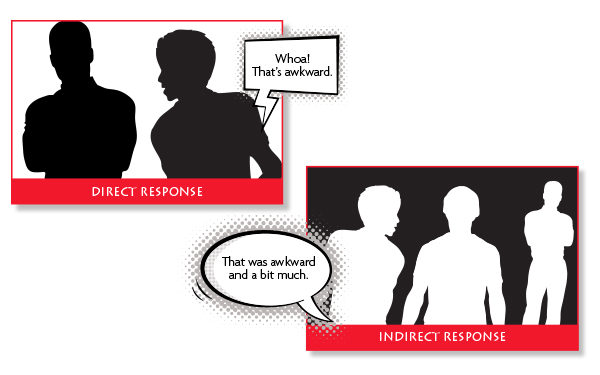
Suggestive Comment

A classmate makes a sexually suggestive comment to another student

  • Direct response: “Whoa! That’s awkward.”
  • Indirect response: “That was awkward and a bit much.”

Thinking men

Party Pressure

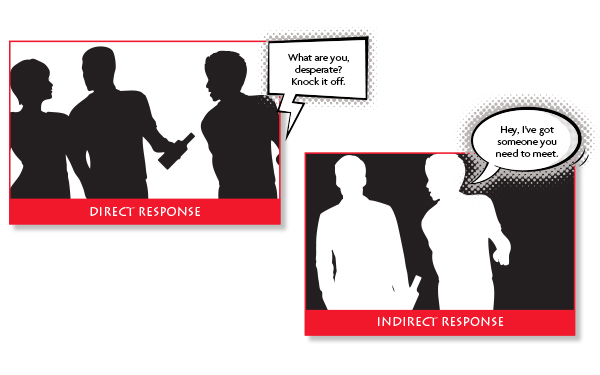
At a party, a guy seems to be paying way too much attention to another student

  • Direct response: “What are you, desperate? Knock it off.”
  • Indirect response: “Hey, I’ve got someone you need to meet.”

Thinking men

Following Someone

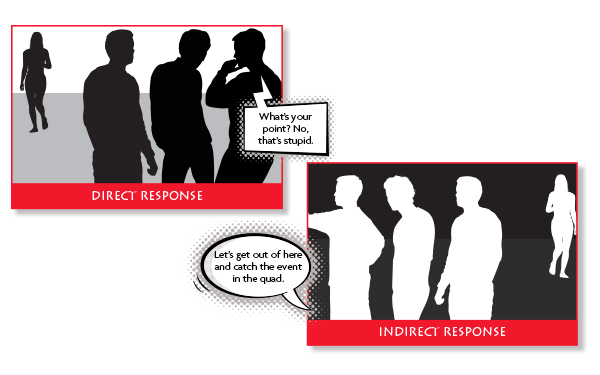
Walking across campus with friends, a student suggests you all follow someone

  • Direct response: “What’s your point? No, that’s stupid.”
  • Indirect response: “Let’s get out of here and catch the event in the quad.”

Thinking men

Drunk and Aggressive

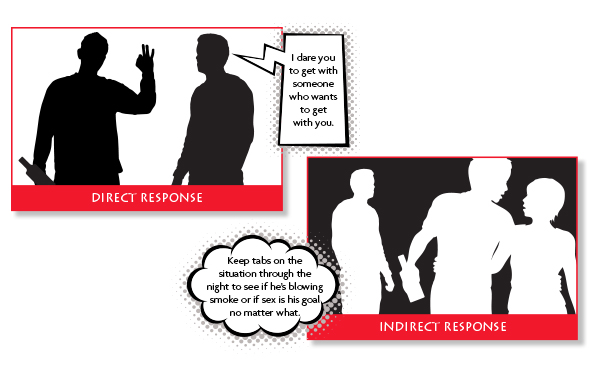
A drunk guy announces he’s going to get  with a girl that night

  • Direct response: “I dare you to get with someone who wants to get with you.”
  • Indirect response: “Keep tabs on the situation through the night to see if he’s blowing smoke or if sex is his goal no matter what.”

Thinking men

Get help or find out more

Bystander tips and training: University of Arizona (Step Up Program)

Strength without violence: Men Can Stop Rape

Mobilizing men to prevent violence: Men Stopping Violence

Liberating campuses from sexual assault: Mentors in Violence Prevention

It’s a men’s issue: Jackson Katz at TED.com

[survey_plugin]

Read More
01 MarFeaturedSexual cultureSexual health

Raise your STI-Q

by Amanda Holst0 Comments

Which sexually transmitted infection (STI) is making a comeback?

What’s up?
Syphilis rates. They’ve nearly doubled since 2005, and approached 17,000 new cases in 2013, says the CDC.

In whom?
Men (90 percent of cases)—especially men who have sex with men (75 percent of cases).

How is this happening?
Via skin-to-skin contact during sex.

How can we stop it?
Condoms, dental (oral) dams, STI screening, abstinence.

Which dead celebs had syphilis?
Bram Stoker, Henry VIII, and Vincent Van Gogh, according to Medscape.

For much more on preventing STIs and getting tested

Read More
19 FebFeaturedSexual assault and harassmentSexual culture

No blurred lines: Clarifying consent

by Leila Yoder0 Comments

Rate this article and enter to win

Consent: What does it even mean?

At an early age, we learn the ability to discern agreement and refusal—like in preschool, when you noticed that touching Jamie’s hair made Jamie pull away, even before your teacher told you to ask permission before doing something with another person’s body or property. Sexual consent is about those same communication skills. Essentially, it’s the same rule as always: Before you touch somebody’s body or property, ask first. Whatever their response, accept it.

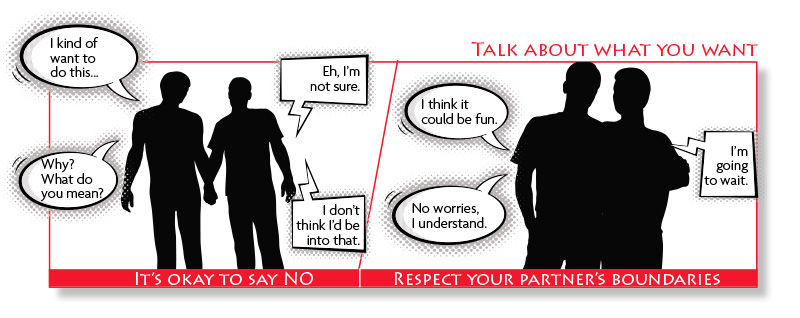
Comic book strip

Affirmative consent

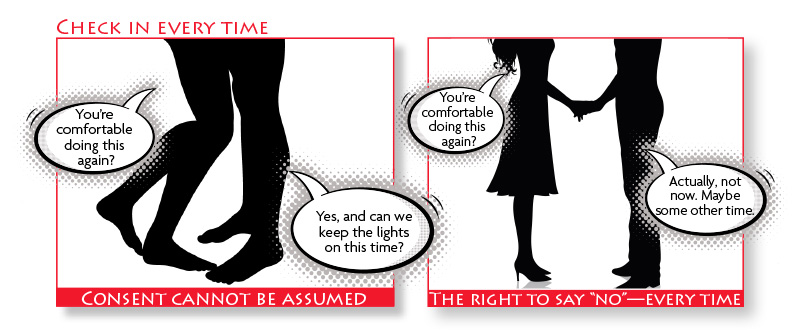
Affirmative consent means that sexual interactions are held to the same standard as most other exchanges. Just as you can’t enter someone’s home or take someone’s stuff unless they’ve said it’s OK, you can’t engage in any form of sexual activity with someone unless they’ve said it’s OK. Consent is never implied and can never be assumed. It can be revoked at any time.

Why are there affirmative consent laws and policies?
The shift toward an alternative consent standard recognizes that the absence of a verbal “no” doesn’t mean consent, just like not fighting back against a mugger doesn’t mean your wallet was a gift to them. Affirmative consent requires a “yes”. Romantic and sexual relationships are about mutuality. Everyone involved should be enthusiastic and engaged.

Comic book strip

What we know

Consent is critical—and it’s not complicated

We can tell when someone is agreeing enthusiastically or grudgingly, or refusing altogether. Our communicative skills work just as well in sexual situations. Unambiguous, positive responses are especially easy to affirm.

What if the cues you’re getting indicate discomfort, lack of interest, or confusion?

  • Stop, slow down, check in. Wait for the other person to make the next move. Take whatever signals you get very seriously.
  • Hold out for situations in which there is genuine enthusiasm and mutual interest.
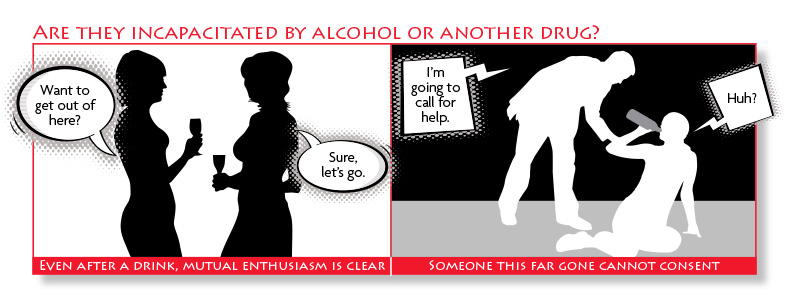
  • Be wary of drunkenness. It’s not impossible to discern consent when you’ve been drinking, but it can skew your interpretations of someone else’s signals.

Comic book strip

Alcohol, incapacitation, and consent

  • “Incapacitation” means the inability to make informed, rational judgments. The use of alcohol and other drugs can be incapacitating.
  • Incapacitated people cannot legally give consent. A “yes” from an incapacitated person (verbal or otherwise) is not consent.
  • You don’t need alcohol or other drugs in order to express interest in someone. If you’re not comfortable engaging in sexual activity unless you’re very drunk, this is something you need to grapple with. Consider talking to people you trust.
  • If you’re not sure how much they’ve had to drink, let it go. If it’s meant to be, it can wait.
  • If someone is incapacitated, seek medical help immediately. Their health could be at risk.

Comic book strip

What if they’re your instructor, boss, or student?

What we all need to know

  • It’s possible to have consensual sex within a working relationship.
  • But if one person has professional or academic authority over the other (e.g., if you supervise them, assess them, grade them, or pay them, or if they supervise, assess, grade, or pay you), a sexual relationship is usually unethical.
  • At almost all colleges, sexual relationships between teachers and their students are forbidden. Even if there’s no explicit exchange of sex for favors, the possibility is enough to make this a no-go zone.
  • If you’re sure that someone you have professional or academic authority over (or who has professional or academic authority over you) is your true love, wait until the working relationship has ended before starting the sexual one.

What if they (or you) are underage?

What we know

  • If you or your partner is underage, you can enjoy an emotionally intimate, non-sexual relationship until you’re both of age.
  • Communication is the key to consent. People of different ages or backgrounds may have different cultural references. Make sure that you and your partners are on the same page.
  • Every jurisdiction has an age of consent, which is the minimum age for legal, consensual sex. Any sex with someone under that age is illegal. In most of the US, the age of consent is 16, 17, or 18.
  • Some states allow sex with an underage person if the older person is close to their age. If you or your partner is under 18, check the laws in your jurisdiction.
  • It’s safest to wait until you and your partner have both turned 18.
  • As long as everyone is legally of age and there is mutual enthusiasm, there is no right or wrong age to have sex, and there is no wrong age difference between partners.
  • Check the age of consent in your state

What if this is harassment?

Harassment is persistently bothering or threatening people and interfering with their ability to live their lives.

Repeatedly directing sexual attention to someone who has not consented to it (e.g., pestering them for sex or a date, repeatedly calling or texting them with sexual solicitations or insults, sending unsolicited nude pictures) is harassment.

This is never consensual and it’s never OK.

If you or someone you know is experiencing harassment, reach out for help. Your school’s Title IX Coordinator can offer you support and point you toward other resources.

What if this is stalking?

Stalking is focusing attention on a person or group in a threatening or fear-inducing way.

This is never consensual and it’s never OK.

If you or someone you know is experiencing stalking, reach out for help. Your school’s Title IX Coordinator can offer you support and point you toward other resources.

What if this is coercion?

Coercion is making someone fear negative consequences if they don’t do what you want.

Note: You might worry that a person won’t like you if you don’t have sex. This is not in itself coercion: People are entitled not to like you. It becomes coercive if a person indicates that there will be negative consequences if you don’t have sex.

If you or someone you know is experiencing coercion, reach out for help. Your school’s Title IX Coordinator can offer you support and point you toward other resources.

What if they look sexy?

Check your assumptions.
Appearance is no indication of availability for sex.

Sexual aggressors use their victims’ appearance in an attempt to justify their aggression. This is never OK.

What if they have a reputation?

Check your assumptions. Previous choices are no indication of availability for sex. In any case, rumors are often false, and may be spread and used by sexual aggressors.

Sexual aggressors use their victims’ sexual histories in an attempt to justify their aggression. This is never OK.

What if they’re an erotic dancer?

Check your assumptions. No type of work, including any role relating to the sex industry, indicates availability for sex.

Sex work isn’t an enforceable contract. No matter what someone does for a living, no one has the right to have sex with them without their consent.

Comic book strip

What we know about sexual role-play & consent

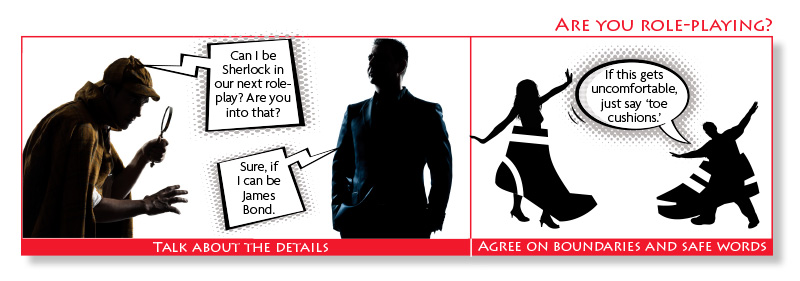
  • Maybe your idea of sexy fun involves playing a character: naughty schoolboy, lustful shepherd, intimate moment between Sherlock Holmes and James Bond. Whatever floats your boat.
  • When in character, pay extra attention to your partner’s signals and the boundaries you’ve discussed.
  • Some role-players choose to use a safe word, hand signal, code movement, or another method agreed on in advance. This is how they communicate a need to stop what’s going on, break character, and reassess.

Comic book strip

What we know about disability & consent

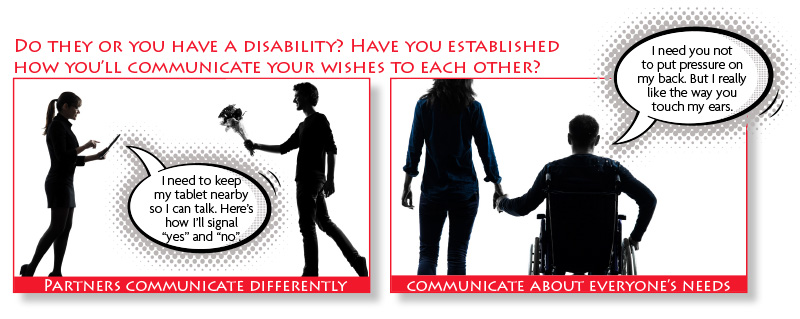
  • No one is obligated to disclose a disability to a sexual partner, ever.
  • However, if you or your partner has a disability that affects how you move, feel, communicate, or have sex, it’s helpful to discuss your needs.
  • To be sure everyone is comfortable, you both need to be able to communicate throughout. This could be by speech, writing, sign language, or an augmented communication device. If one of you has trouble speaking, agree on signals for “yes” and “no.”
  • Talk about any modifications or accommodations that might be necessary. E.g., maybe certain positions can maximize mobility or avoid pain.
  • If you have any questions or concerns, ask and answer explicitly.


Get help or find out more

Video demos of affirmative consent: Ultraviolet

Guide to private consent and public activism: The Consensual Project

Consent and alcohol: Cornell University

Verbal and nonverbal consent: Scarleteen

Campus advocacy on sexual assault: Know Your IX

[survey_plugin]

Read More
01 JanFeaturedSexual assault and harassmentSexual culture

Sexual assault on campus: Survivors look to their community

by Amanda Holst0 Comments

Rate this article and enter to win $1,000
Note: This feature contains graphic details about sexual assault and violence.

We asked about sexual assault, and you told us. The incidents you described occurred in residence halls and a “rape closet,” at parties and in parking lots, at high school, at home, on social media, and beyond. They included indecent exposure and groping, stalking and sexual coercion, and rape. The aggressors were friends, acquaintances, strangers, coworkers, intimate partners, and relatives.

The vast majority of accounts came from women who had been sexually assaulted by men—as children, teens, or adults (often, as college students). We also heard from men who had been assaulted, sometimes by women. They had struggled with the societal unwillingness to recognize their experiences as assault.

Student Health 101 thanks every student who responded. The students quoted here are identified by their year and college or university, or not, depending on their preference.

In the residence hall and the rape closet

Among women students who’d been sexually assaulted as adults or children, shame and self-doubt were common themes. Survivors’ self-blame reflects the blame that comes at them from society.

“I was raped in my residence hall room”
“Many questions were asked. ‘Had you been drinking?’ ‘What were you wearing?’ ‘Who?’ ‘Did you fight back?’ ‘What time?’

“What I really needed to hear was ‘I believe you,’ ‘I love you,’ ‘It’s not your fault.’

“The society we live in teaches us to ask questions rather than listen. Survivors deserve more than that. We deserve to know that those who love us will be there for us no matter what.

“I was raped in my residence hall room, in sweatpants and one of the largest T-shirts I own and a sports bra, hair up and no make-up, without a drop of alcohol or drugs in my body. It was late, and this young man was someone I had had relations with before, but the fact of the matter was that I said ‘no’ and he did it anyways. That is what rape is: sexual intercourse without consent.

“Please listen to someone, rather than question them, the next time they come to you in confidence. Tell them you believe them. Tell them it wasn’t their fault. Tell them you love them. Tell them until they believe it.”
—Second-year undergraduate, Lasell College, Newton, Massachusetts

The “rape closet”
“I was a freshman at a party. My ex-boyfriend and a roommate put me in a closet under the stairs to sleep off my drunkenness. I was told later that a male I did not know told them they should all ‘run a train’ on me (have sex with me). They said no. At around 5 a.m., that man came in and choked and raped me.

“My ex and his roommates started blaming me for the rape and making references to the ‘rape closet’ on Facebook. They told me if I wasn’t drunk that night it wouldn’t have happened. They called me and my roommates (who were very supportive of me) the ‘rape pity party brigade.’

“I started having panic attacks. My heart would race and I would hyperventilate with no cause. I was diagnosed with PTSD, put on anxiety medication, and underwent counseling. I ended up going through with a court case. Getting justice is possible. He got three years in prison and had to register as a lifetime sex offender. I found out that when he was 14 he raped a 5-year-old. I highly doubt I was his only adult victim.”
—First-year graduate student, California Lutheran University, Thousand Oaks, California

“I bet I can make you love men”

In the residence hall and the rape closet

“I bet I can make you love men”

“He laughed. ‘You’re too pretty to be a lesbian! Have you ever had sex with a guy?’

“I said I hadn’t had my first experience with either gender. He replied, ‘If you haven’t slept with a guy, you have no idea whether or not you like it; I bet I could make you love men.’ He grabbed me by my hair. I was kissed and touched with force and without consent. He kept telling me to stop fighting it, learn to enjoy it, and not to be a prude.

“I felt so empty. I felt like a part of me had been taken away with him and that I had been made dirty. I have come to terms that this was an act of violence and had nothing to do with who I am. People need to know that [by speaking up] they can prevent other people from getting hurt too.”
—Second-year undergraduate, Utah State University, Logan

“It’s true what they say: You freeze”

“It’s true what they say: You freeze when it happens. When you see stories like this and it hasn’t happened to you, you know you’d yell for help, you’d push him/her away in disgust. But it never happens that way.

“I was in an art gallery and he just started talking to me. He was nice and had a soft voice. We talked about God. We walked around the gallery together; ‘Come on, let me show you something.’ We’d pause in front of pieces of art for some time in silence. That’s the only part of the story I can bring myself to talk about.

“It’s true what they say: You blame yourself. Before, he looked down at my legs and asked, ‘Aren’t you cold?’ But he was smiling. I should’ve known.

“I feel strange when men touch me, even by accident. I feel hot inside and I just want to curl up. It has affected me to this day. And it wasn’t even that bad compared to other stories. It wasn’t rape. Other women are much stronger than me.”
—First-year undergraduate, University of Saskatchewan, Saskatoon

In no-man’s land

Men’s stories involved male and female aggressors. A recurring theme was society’s resistance to the concept that men can be sexually assaulted.

“You’re gay—you must be liking it”
“I was part of a sports team at my high school, trying to be a normal teenager. The other guys on the team labeled me gay, homo, fag, and I couldn’t tell them otherwise. One late night after practice, they locked the door of the change room. They stripped me naked. Each guy held me down so I couldn’t escape, and took their turn forcing me to do things I did not want to do. ‘You’re gay so you must be liking it anyway,’ they said.

“It haunts me to this day. There are times when I go to sleep and all I can see are their disgusting faces holding me down. People who haven’t been sexually assaulted never understand. How could they? You need to seek closure within yourself. The only reason I can wake from the nightmare is because I took it upon myself to charge every single one of them. I made sure that they either spent time in jail or were charged a huge chunk of money.

“Although someone might not understand what you’re going through, you need to tell someone. You need to report what happened, who, when, where, everything, to the best of your abilities. To the people who are trying to help those who have been victims, be an open hand, a shoulder to cry on.”
—Second-year undergraduate, University of New Brunswick, Fredericton

“My friends would say guys can’t get raped”

“My friends would say guys can’t get raped”: Frat party, friends, and foster care

“My girlfriend trusts me less after I told her”
“At the end of the academic year, I became homeless, simply because my off-campus leases ended/started one week apart. Twice in that week I felt very pressured to perform sex acts with female friends who let me sleep over. I felt diminished by both events.

“I’ve been completely honest with my new partner, and she has judged me, held me responsible because I’m the man in the situation. She trusts me less because I was honest with her. She is also a victim, and it hurts a lot that she can’t seem to understand my side.”
—Undergraduate, New York

“My friends would say guys can’t get raped”
“We were dancing and kissing at a frat party. Without asking, she reached down my pants and tried to give me a hand job, and made motions toward having sex there and then. I was uncomfortable doing it in front of people in a crowded basement. She was very drunk and ended up causing more pain than pleasure.

“I wasn’t sure what to do. It’s a rare situation where a guy stops a girl from initiating sexual contact. Her friends dragged her away, probably thinking I was trying to take advantage. I haven’t spoken to her since. I haven’t mentioned it to anybody. I feel my male friends would wonder why I am not happy about it, and my female friends would tell me that guys can’t get raped.”
—Third-year undergraduate, Johns Hopkins University, Baltimore

“I was assaulted by my caregiver”
“I was sexually assaulted by the caregiver when I was in a foster home. Her husband (a truck driver) was gone, and she took advantage of me. I was 13 years old at the time and unsure of what was going on. I tried to report it to DHS and was told it was all a fantasy. I became very reserved toward everyone, became a loner for many years. I didn’t trust anyone for a long time.”
—Undergraduate, Iowa

Abused online, coerced, and stalked

Survivors described abuses across the continuum of sexual assault and harassment.

“I could not look in the mirror, I hated myself so much”
“I was hanging out with some older people I was trying to be friends with, but was having a hard time getting into the group. The group leader said he would let me be friends with them if I gave him head. Desperate for acceptance, I did it. He kept his word and let me hang out with them, but afterward all I wanted was to be alone. I could not look in the mirror without wanting to yell, scream, cry, and pull my hair out because I hated myself so much.”
—Second-year undergraduate, University of North Texas, Denton

Clicking, grabbing, homophobia, and stalking

Clicking, grabbing, homophobia, and stalking: The continuum of sexual violence

Homophobia at the mall
“I’ve been in a relationship with my boyfriend for three years, and am proud and happy to hold his hand in public. One time when we were at the mall, a group of about 10 men followed us. They said, ‘Yo, my boy needs some lovin,’ and ‘You gaga don’t belong here.’ I do not believe in confrontation, but the moment we got into the car I cried my eyes out. I could not believe grown men could treat us like that. They have no idea what we are like, where we come from, etc. For them to demean us in such a way is inexcusable. But I am stronger than those men. I use that incident to allow me to be strong and always smile at the haters. I am happy where I am, and they will not bring me down.”
—Third-year undergraduate, Rowan University, Glassboro, New Jersey

“People think the assault made me asexual”
“I was studying abroad. I was walking under a bridge in daylight, with people around, when the man who had been sleeping there grabbed my chest. I have dysphoria [emotional discomfort] about my chest, and being forcibly reminded that I am not flat at the same time as being assaulted was a really bad combination. I spent a while crying. It was a good month before I was able to go back under the bridge.

“The school had already tried to have me sent home because of my autism. I realized that presenting them with an actual safety issue was an involuntary ticket home, so I didn’t report it. Now that I am home, my dysphoria is a lot worse than before. My asexuality helps me avoid some possible triggers, since there’s not going to be any consensual sexual acts and flashbacks. But people assume the asexuality is because of the assault, when actually I was asexual before.

“Even if your story fits none of the dominant narratives, what happened is still real, can still be traumatizing, and it’s OK to need support dealing with it, whatever support looks like for you.”
—First-year graduate student, University of Rhode Island, Kingston

“One click can really hurt”
“My information was pulled from Facebook and Snapchat and manipulated to be posted on websites that contained adult sexual content. I was confused: I was receiving calls and messages from people on those sites. I tried going to the police and university staff. Now, I always tell people to be wary of things they post. If I see cases like that, I try to make my friends understand how one action, click, or hurtful message can really harm someone else.”
—Third-year undergraduate, University of California, Irvine

The impact on survivors and communities

Survivors lost their trust in others, their sense of safety, and their self-belief. Some described the impact on their relationships, capturing the harm that sexual violence inflicts on communities and social networks.

“My feelings would never matter”
“It heavily impacted my college life, how I felt about myself and my social environments. I was just an object. My opinions or feelings would never matter. I wasn’t good enough. I felt used and scared. I was repulsed by myself, by my reflection. To this day, what happened to me has given me a general distrust for everyone.”
—Undergraduate, Massachusetts

What sexual assault means for survivors and communities

“I couldn’t hang out with my guy friends”
“Afterward it was hard to hang out with some of my best friends, because they were guys. I was so afraid of guys.”
—Second-year undergraduate, University of West Georgia, Carrollton

“I haven’t trusted anyone since I was 15”
“That was the moment I stopped trusting anyone. Literally, if you said the sun was shining, I would go and verify. I am constantly worried someone is trying to hurt me.”
—Fifth-year undergraduate, University of Alaska, Anchorage

“I was always on guard”
“I ended up leaving the apartment complex [at college] so I didn’t have to see the guy again. I didn’t want to go out as much, I didn’t want to be alone with people, I didn’t want to drink with other people. I was always on guard. I started making up excuses. I would say, ‘I have so much homework,’ or, ‘I don’t feel well and I just can’t go out.’ Since I switched to a different college in another state, I’m starting to open up a bit more. Now I feel that not every person is the same. Nine times out of ten, nothing will happen.”
—Fourth-year undergraduate, University of Massachusetts, Amherst

Survivors’ messages to survivors

“You still deserve good in the world”
“Your body isn’t ruined or dirty because someone else touched it without permission. You deserved good in the world before it happened, and you still deserve good after. Please don’t let someone else’s ill intentions become your new view of yourself and your body. Talking to someone you trust really helps.”
—Second-year undergraduate, University of Massachusetts, Lowell

“My boyfriend listened without judgment”
“Looking back, I wish I had told more people. Everyone needs support, whether they recognize it or not. It’s not something that you need to experience alone. My boyfriend was very supportive. He was almost as mad as I was at the police. The biggest thing he did is that he listened without judgment.”
—Fourth-year undergraduate, University of Massachusetts, Amherst

“I can move on and do great things”
“Something that helped me is to first tell someone who you trust and who you trust will have the right reaction. Second, to know that even though it hurts, it is not yours to carry. I believe God wants me to give him the sadness and anger so that I can move on and do great things. I was not in college at the time. I was only two years old.”
—Undergraduate, New Hampshire

“Everyone has the right to safety on campus”
“Being stalked during college is terrifying, especially when your stalker lives in the same dorm. Seek help, make it known, let as many people know about your situation as possible. Let staff, educators, directors, etc., know. Do not stop until results have been made that ensure your safety. Everyone has the right to live in safety while attending campus.”
—Graduate student, Canada

How to take that knife out
“There’s not a thing I can do to change what happened, but through prayer and forgiveness I was able to walk away from it. If you don’t forgive, it’s like that knife of pain they put into you; you’re just digging it around in your belly, saying, ‘This is what happened to me, look how they hurt me! Look how sharp this knife is!’

“Forgiveness is the act of pulling that knife out and dropping it. It hurts. It’s not because they deserve to be forgiven. It’s because you deserve to walk free of it. Forgiveness is the only way to take that knife out.”
—Third-year undergraduate, Pacific Lutheran University, Tacoma, Washington

Intimate betrayals: Abuse by partners and family members

For many, sexual assault and coercion were part of intimate relationships with boyfriends and husbands (occasionally, girlfriends). Others had been sexually abused by family members during childhood.

A bomb went off
“I didn’t realize it was rape until I was in a social problems class and the professor was talking about date rape. It was like a bomb went off—a total whirlwind, and I was the only one experiencing it. The room was actually spinning.”
—Third-year undergraduate, University of Wisconsin-Parkside

“I’ve tried to suppress this memory”
“I would have never called it rape or sexual anything at the time, but lately I just flashback and relive the experience. When I was 12, my uncle told me to lay with him to play a game. He began touching me and asking if I feel ticklish. He told me that these were the places boys will touch and it will make me feel good. He inserted his fingers inside me and kept asking how it felt. All the while my sister, who was about six, was sitting in the corner playing with her dolls. I went to my mother’s room, but I knew she would never believe me. I didn’t want my father angry either. I stood over her bed and walked out and cried on the bathroom floor.

“I never spoke to anyone about this. I never saw a reason to mention it. Thinking back, I feel vulnerable, used up. Whenever I see my uncle at reunions, I just wonder if he truly chose to forget or he knows what he did and regrets it every day, just how I regret I never told my mother. I have tried to suppress this memory for the longest of times. I hope this helps at least someone.”
—Undergraduate, New Jersey Institute of Technology, Newark

“He said he was thinking of suicide”
“I became roommates with another gay male and he told me he loved me. I said nothing would happen. Every other night he would ask to be with me. He’d turn into a wreck, saying it would make his life better and he’d thought about suicide. One night, when we saw each other at the bar, he sexually assaulted me there.”
—Student, Omaha, Nebraska

How professionals responded

Several survivors who participated in our survey had successfully reported assaults to the police or campus authorities. Others described unhelpful responses from professionals.

The college reporting process
“I was 20 and a student during winter term. I made sure to not lead him on, but it was still out of my control. It made me feel powerless. I had tried to be his friend. I reported to my area coordinator and then later the public safety staff. I had to give a statement at the student board. Long process. Took three months to come up with a verdict.”
—Undergraduate, Oregon

Facing police skepticism
“My boyfriend gave me the courage to go to the [town] police. The police said, ‘You had some history with the guy; is it possible that you said yes in the moment, or that your boyfriend is making you say this?’ I tried to convince the police that I was going to them with the best intentions, that this wasn’t a case of me having regrets the next day. They took a report and sent me on my way. There wasn’t any follow-up. I didn’t talk to anyone on campus about what happened. I didn’t tell my friends. I figured if the police can’t do anything, what could anyone else do?”
—Fourth-year undergraduate, University of Massachusetts, Amherst

Blocked by a school counselor
“I was a freshman in college. It was during a snowstorm, after a beer and a round of MarioKart. He grabbed my neck and threw me into his bedroom, where I was sexually assaulted. The school counselor told me that since I had been drinking and had willingly gone to his apartment, I shouldn’t report it. It took me a long time to get the support I needed to move forward.”
—Undergraduate, Massachusetts

Recovering from camp
“After my first year of college, I worked as a summer camp counselor. I was sexually assaulted by two male counselors in the safe lounge while 15 other counselors watched and did nothing. The camp found me at fault and gave me the option to get over it or quit. It was three years until I told anyone. The aftermath left me depressed, nervous, and afraid of men. When I was 21, I finally decided I wanted to take my life back. That is when I told my parents. After years of therapy and baby steps, I finally feel like I am back to the 18-year-old who left for camp five years ago.”
—Undergraduate, Virginia


Get help or find out more

Find local services and other resources: NotAlone.gov

Resources from student activist survivors: Know Your IX

Info and resources on campus safety: Clery Center for Security on Campus

Sexual violence resources: Rape, Abuse, and Incest National Network (RAINN)

Sexual violence resources: National Sexual Violence Resource Center

[survey_plugin]

Read More
01 DecRelationshipsRomantic relationshipsSexual cultureSexual health

Condom Pro By Bedsider LLC

by Amanda Holst0 Comments

Why we love it:

Get the hang of condoms while learning sweet pieces of condom gossip for sharing with friends or a partner (pillow talk—how romantic does it get?).

Why do we like condoms, again? Because they’re the only form of birth control (other than abstinence) that protects against sexually transmitted infections (STIs). Condoms are also useful contraceptives. With typical use, male condoms are 82 percent effective at preventing pregnancy. With correct use, they’re 98 percent effective. That’s why correct use mattersâ€Ķa lot.

Condom Pro is a game that educates you while you play. Practice opening the condom and putting it on everyday objects. You have to put the condom on correctly to move to the next round. Tear the condom when opening the package? Try again! Put the condom on upside down? Try again! Wait too long to take the condom off? Try again!

The facts on Condom Pro are fun too. Did you know not to use two condoms at the same time? (Check out this month’s ask the relationship educator for more on this.) What about the scents that are most likely to turn someone on? Knowledge is sexy, people. In celebration of World AIDS Day, use this app to help protect you and your partner.

Bedsider.org is a birth control support network operated by The National Campaign to Prevent Teen and Unplanned Pregnancy. They provide information on birth control use and offer reminders to take birth control on time (to make sure it’s most effective).

Price: Free (must be at least 17 years old to download)
Devices: iPhone
For more information, CLICK HERE.

Similar App

App: iCondom
By Bedsider LLC
Price: Free
Devices: iPhone
For more information, CLICK HERE.

Read More
01 NovFeaturedSexual assault and harassmentSexual culture

Profile of a friend: How to be an ally to survivors of sexual assault

by Erica Hersh0 Comments

Rate this article and enter to win
No one wants to think that our friends or acquaintances might have been sexually assaulted or abused. Yet statistics suggest we all know survivors, whether or not we’re aware of it.

Sexual assault and abuse survivors who receive positive social support are less likely to develop post-traumatic stress disorder, depression, or substance abuse issues, research shows.

“When a survivor of sexual violence chooses to disclose to a friend, this friend can help set the tone for the recovery process,” says Kelly Addington, founder of One Student, an advocacy organization addressing sexual assault in student communities. “Focusing on the survivor and how you can support them is much better than focusing on the attack.”

Your approach

Recognize your value

The friend of a sexual assault survivor can make a real difference to the survivor’s coping and recovery—whether in the immediate aftermath of an assault, in the short term, or over a lifetime.

Your friend’s reactions and emotions will vary, and you too may face new challenges and demands. Reassure yourself that you have what it takes.

  • Be present
  • Stay calm
  • Listen to what your friend tells you
  • Think about how you can offer support
  • Talk about the available options, and let your friend decide what’s best
  • Look after yourself too

“Don’t worry about being perfect, but do recognize the importance of your role.” - PACT5

For help managing your own feelings.

Listen and believe

Here’s what you can do right away after your friend is sexually assaulted or confides in you about a past assault or abuse:

  • Listen with compassion
  • Let your friend express her feelings (crying, screaming, or remaining silent)
  • Believe your friend
  • Don’t ask a lot of questions
  • Support your friend unconditionally: Don’t judge him or the circumstances

Sources include PACT5

Say it's not her fault

What to say

What not to say

“It wasn’t your fault.”

“You’d had a lot to drink.”

“I’m here for you.”

“Get over it.”

“If you need someone to come with you, I will.”

“Focus on moving on.”

“I’ll support whatever you choose to do.”

“Everything’s all right.”

“What can I do to support you?”

“He probably misunderstood you.”

“I’m sorry this happened to you.”

“It couldn’t have been that bad.”

“How do you want me to act when I see him?”

“I’ll go beat him up”


For more on what not to say

Respect her boundaries
  • Let your friend decide how much to talk with you about the assault
  • Let your friend decide who will know about the assault
  • Don’t talk about the incident with others without getting his or her permission
  • Ask before hugging. Your friend might not want to be physically touched

Sources include the Pennsylvania Coalition Against Rape

Learn about sexual assault
  • In most sexual assaults, the survivor knows the perpetrator
  • Most sexual assaults are not reported to the police
  • Alcohol is often used as a weapon; most sexual assaults on college students are associated with alcohol use
  • Sexual assault is premeditated; it is not a “misunderstanding”
  • People of any sexuality or gender can be sexually assaulted
  • False accusations of sexual assault are very rare; studies suggest 2—4 percent of accusations are false, about the same rate as for other violent crimes

Right after an assault

Allow him control

When your friend was sexually assaulted, he or she was not in control of the situation. For your friend to regain a sense of empowerment, it’s important to let him or her make decisions about what steps to take next. This includes:

  • Whether or not to report the assault
  • How to report the assault
  • Who to tell about the assault
  • Which coping resources to draw on

Sources include the Pennsylvania Coalition Against Rape

Help him to a safe place

You’ll want to make sure your friend is in a safe place.
Encourage him or her to stay with a trusted friend or acquaintance for emotional and practical support. For example:

  • Another friend’s residence hall or apartment
  • A relative’s home
  • A domestic violence shelter
Help him seek medical care

Whether or not your friend wants to report the incident, encourage him or her to seek medical care.

Health care providers can:

  • Provide emergency contraception
  • Test and treat your friend for possible sexually transmitted infections (STIs)
  • Perform a rape exam and collect evidence in case your friend decides to prosecute, now or later
  • Treat any physical injuries

See Student Health 101 December 2014 for a guide to accessing professional services and support after sexual assault.

Suggest reporting (no pressure)

Most sexual assault survivors don’t report the incident to police.
Anticipate that your friend might tell you he or she wants this to go no further.

The possible reasons include:

  • He knew the perpetrator (boyfriend, girlfriend, friend, or classmate)
  • She’s afraid that no one will believe her
  • He’s afraid of getting in trouble for using alcohol or other substances illegally
  • Shame

Whatever the reason, it’s your friend’s decision. Support his decision and process. If he prefers not to, don’t pressurize him.

Sources include PACT5

See Student Health 101 December 2014 for a guide to accessing professional services and support after sexual assault.

Learn about short-term health risks

Panic attacks If your friend experiences a panic attack in your presence:

  • Ask her to sit down and place her feet on the floor
  • Tell her to take deep breaths
  • If she takes prescribed medication for panic attacks, remind her it’s available

Flashbacks During a flashback, survivors may relive the sexual assault in their mind. If your friend experiences a flashback in your presence:

  • Tell him you know it feels real, but it’s not really happening
  • Turn on a soft light
  • Turn off triggering music or television shows
  • Encourage him to take slow, gentle breaths
  • Reassure him that he is safe and the perpetrator isn’t there
  • Don’t press him to talk about it, which might trigger him further
  • Just be there for your friend during and after the flashback

Sources include Pandora’s Project

Reporting

Help her consider options

These resources are typically available to sexual assault survivors on campus:

  • Campus safety/security
  • Office of Residential Life
  • Campus judicial affairs or Dean of Students
  • Off-campus police
  • Sexual assault response coordinator
  • Student counseling center
  • Student health services
  • Rape crisis center or hotline
  • Resident advisors (RAs)
  • Online school notification form (some schools offer anonymous reporting online)
  • Trusted professors

If anonymity is a concern, ask the person first if he or she is required by law to report the sexual assault: “Are you a mandated reporter?”

See Student Health 101 December 2014 for a guide to accessing professional services and support after sexual assault.

Respect her decision

The decision about whether to report the sexual assault is entirely up to the survivor.

Most sexual assaults are not reported to the police. Here are some of the reasons why:

  • The perpetrator is well-known and was previously trusted (e.g., the perpetrator is or was a boyfriend, girlfriend, friend, or classmate)
  • Alcohol or drug use was involved
  • The survivor is afraid of not being believed
  • The survivor is afraid of peers or family finding out
  • The survivor fears a lengthy, stressful legal process
  • Shame

Remember, the most important thing you can do for your friend is to be there to listen and support her or him.

Sources include the Pennsylvania Coalition Against Rape

Provide emotional and practical support

Your friend’s world has just been turned upside down. Providing her or him with positive support is critical.

Emotional support

  • Let your friend know that the perpetrator bears sole responsibility for the assault
  • Don’t pressure your friend to talk about it
  • Be available to listen and just be there when he or she needs you
  • Ask your friend what would help

Practical support

  • Discuss the resources available on and off campus
  • Offer to accompany your friend to appointments with the police, campus authorities, and health care providers
  • Encourage self-care. Do some of these things with your friend if possible:
    • Meditating
    • Conscious relaxation exercises
    • Physical activity
    • Being with supportive, caring people
    • Keeping a journal

For more self-care suggestions.

Know your school's role

Campus Sexual Violence Elimination (SaVE) Act (2013)

  • Requires campuses to include incidents of domestic violence, stalking, sexual assault, and dating violence in their annual crime statistic reports
  • Students or employees reporting incidents must be informed of their rights (in writing) to:
    • Get help from campus authorities if they decide to report to the police
    • Change their living, work, transportation, or academic situation for safety, if necessary
    • Obtain a restraining order or no-contact directive against the perpetrator
    • Be given contact information for mental health, health victim advocacy, legal assistance, and any other relevant services on campus or in the community
    • Be given a clear description of the school’s disciplinary process and possible outcomes
  • Sets minimum requirements for disciplinary procedures

Clery Act (1990, with subsequent amendments)
Under the Clery Act, colleges and universities must:

  • Publish campus crime statistics and policies
  • Maintain a public crime log
  • Issue warnings when a crime poses a threat to students and faculty

Title IX (1972)

  • Title IX prohibits gender-based discrimination in education, and applies to all genders
  • Schools must establish procedures for handling sex discrimination, sexual harassment, and sexual violence complaints
  • Schools must take immediate action to support and protect the person who brought the complaint
  • Schools cannot encourage mediation instead of a formal complaint in cases of sexual violence
  • Schools cannot encourage any student to discontinue his or her education

What not to do

Don't make rash promises

Don’t make any promises that you can’t keep or that aren’t realistic. For example:

  • Don’t promise that the victim will never be hurt again
  • Don’t promise that the offender will go to jail

Sources include the Pennsylvania Coalition Against Rape

Don't say what she "could" have done

Accusatory statements only place guilt and blame on a sexual assault survivor.
The only person to blame for sexual assault is the perpetrator.

What not to say:

  • “You shouldn’t have gotten drunk.”
  • “But you knew that guy was trouble.”
  • “Why didn’t you think about calling me for a ride?”
  • “Did you actually say ‘no’?”
Don't excuse the offender

Rule # 1 Don’t ever try to excuse the perpetrator’s behavior, even if it’s a boyfriend, friend, or acquaintance of the survivor. Perpetrators are responsible for their own behavior.

It doesn’t matter if the survivor was wearing sexy clothing or if alcohol or drugs were involved.

Key points:

  • “No” really does mean no
  • A person cannot give consent when incapacitated by alcohol or another drug
  • There are no “accidental” sexual assaults
  • “Submitting” to assault can be a survival tactic to avoid greater harm

Sources include the Pennsylvania Coalition Against Rape

Don't propose retaliation

As much as you may want to, don’t suggest retaliation or revenge
involving yourself or anyone else.

Such confrontations risk:

  • Placing you and/or others in danger
  • Generating additional trauma for your friend

Aftermath

Help figure out her needs

Various resources are available to help your friend. Your guidance and support is important during this difficult time. Helpful resources and strategies include:

  • Local rape crisis center
  • Medical providers
  • Counselors, on or off campus
  • Advocacy groups
  • Police 
  • Campus security
  • Office of the Dean of Students
  • Religious institutions
  • Friends
  • Shared, enjoyable activities

For further resources, see Not Alone.

Check in regularly

It’s important to check in regularly with your friend following a sexual assault or abuse. Keep in mind:

  • It’s okay to ask in private how she or he is doing
  • Talk about the assault only if your friend wants to
  • Respect and protect your friend’s privacy
  • Watch for behaviors that could indicate stress, depression, or trauma, e.g.,
    • Sleep disturbance
    • Changes in alcohol or other substance use
    • Volatility in mood
    • Unwillingness to participate in activities she or he previously enjoyed
  • Reiterate your willingness to support or assist in any way that is helpful
  • Balance being supportive with not being overbearing
  • Ask your friend what would help. For example:
    • A night out at the movies
    • Going for a run together
    • A chaperone at potentially stressful appointments
    • Some errands taken off her plate
    • Help liaising with professors, if he is struggling academically
Encourage counseling

Sexual assault is a traumatic experience. Your friend may need help with difficult emotions.

If he or she has tried counseling before and didn’t find it helpful, it’s worth another attempt with a provider who fully understands sexual assault and abuse.

Be alert for signs that your friend is struggling to cope. These can include avoidance—denying the assault and its implications—or self-blame.

For support, contact:

  • A rape or sexual assault crisis center
  • The college counseling center
  • Advocacy and support organizations that provide local referrals, e.g., RAINN

See Student Health 101 December 2014 for a guide to accessing professional services and support after sexual assault.

Ask how to behave towards offender

In most sexual assaults, the survivor knows the perpetrator.
If your friend knows the assailant, there’s a good chance that you may know this person too.

If you know both the survivor and the perpetrator:

  • Ask your friend how she’d like you to handle it
  • Respect her decision

Past assaults and abuse

Acknowledge his resilience

After a sexual assault, your friend is both suffering and surviving. Survivors deal with their emotions differently. They need to grieve and heal in their own way. Recognize that recovery varies and can take years. Don’t ask your friend if she is done dealing with it yet, or tell him to move on.

Here’s what can help promote resilience and the healing process:

  • Positive, supportive responses from others, including empathy, belief, and understanding
  • Practical support, including access to resources
  • Speaking out about sexual assault
  • Social acknowledgment of the impacts of sexual assault
  • Strong, supportive social networks

Sources include Pandora’s Project and the Australian Institute of Family Studies

Encourage counseling

Sexual assault and abuse is a traumatic experience. Your friend may be struggling, but might pretend that things aren’t that serious. Talk to him when you have concerns. Professional counseling can help survivors handle difficult emotions.

  • Encourage your friend to go to the student counseling center or rape crisis center
  • Let your friend know that you’ll go to the appointment if she wants you to
  • Let your friend decide whether or not to seek professional help

Ask your friend what kind of support he or she needs from you. This isn’t a one-time question. Your friend’s needs are likely to change over time. Unless your friend is putting himself at risk of harm, follow his wishes.

Sources include the Pennsylvania Coalition Against Rape

See Student Health 101 December 2014 for a guide to accessing professional services and support after sexual assault.

Watch for behavior change

It’s important to notice any behavior changes in your friend following a sexual assault. Let your friend know that she or he isn’t alone, and suggest professional counseling to help with difficult emotions.

Red flags include:

  • Persistent irritability
  • Loss of interest in activities
  • Changes in sleep patterns
  • Changes in appetite or weight
  • Changes in energy level, e.g., exhaustion
  • Nightmares or flashbacks
  • Fears for her own safety
  • Hyper-vigilance
  • Social withdrawal
  • Excessive guilt, self-blame, or feelings of worthlessness
  • Difficulty concentrating
  • General mistrust
  • Thoughts of suicide

Sources include the College of William and Mary

Learn about long-term health risks

Possible long-term health and wellness issues:

  • Post-traumatic stress disorder
  • Depression and/or anxiety disorders
  • Sexual distress
  • Substance abuse
  • Eating disorders or poor body image
  • Sleep disorders
  • Physical health problems, which can be chronic
  • Crisis of faith

The chances that a victim will develop post-traumatic stress disorder after an assault are between 50 and 95 percent—according to the Population Information Program (2000).

Other possible impacts:

  • Dropping out of college
  • Lower income
  • Higher health care costs

Sources include the Pennsylvania Coalition Against Rape

Get help or find out more

National Sexual Assault hotline/RAINN

  • 1-800-656-HOPE
  • https://ohl.rainn.org/online/
  • Phone or online chat
  • Information about local resources, emergency protocols, and state law

National Domestic Violence hotline

  • 1-800-799-SAFE (7233)
  • 1-800-787-3224 (TTY)
  • 1-855-812-1001 (video phone for deaf callers)
  • https://www.thehotline.org/what-is-live-chat/
  • Phone or online, many languages

Love is Respect

  • 1-866-331-9474
  • Text loveis to 22522 and click on Live Chat

School Violence Law

  • 1-877-WASHDC-1 (1-877-927-4321)
  • Skype DCLawFirm
  • Google+ WASHDCLawFIRM
  • Sexual assault, school violence, hazing, Title IX violations
  • Legal information, referrals, and advocacy services

Trevor Project helpline

  • 1-866-488-7386
  • Text Trevor to 1-202-304-1200 (standard text messaging rates)
  • https://www.thetrevorproject.org/pages/get-help-now
  • Crisis intervention for LGBTQ people ages 13–24 by phone or online
[survey_plugin]

Read More
01 SepFeaturedSexual assault and harassmentSexual culture

Profile of a perpetrator: Who is responsible for sexual assault on campus

by Heidi Priebe0 Comments

Rate this article and enter to win
Sexual assault on campus has long been perceived as a problem of miscommunication between young, drunk adults. The evidence refutes this. Campus perpetrators of nonconsensual sexual acts have traits in common with convicted rapists, according to research.

College perpetrators are predatory and their assaults are premeditated. They use alcohol, rather than force, to incapacitate the people they target. “College sex offenders have common characteristics,” says Dr. John Foubert, associate professor at Oklahoma State University in Stillwater, and a specialist in gender and violence issues.

Attitudes and Beliefs

Hostile to women

Lisak, D. (2011). Understanding the predatory nature of sexual violence. Sexual Assault Report, 14, 49-50, 55-57.

  • This 2011 review by psychologist David Lisak outlines the characteristics of “undetected rapists,” including college perpetrators.
  • “When compared to men who do not rape, these undetected rapists are measurably more angry at women, more motivated by the need to dominate and control women, more impulsive and disinhibited in their behavior, more hyper-masculine in their beliefs and attitudes, less empathic and more antisocial.”

Forbes, G.B., Adams-Curtis, L.E., White, K.B. (2004). First- and second-generation measures of sexism, rape myths and related beliefs, and hostility toward women: Their interrelationships and association with college students’ experiences with dating aggression and sexual coercion. Violence Against Women, 10(3), 236-261.

  • This 2004 study explores how sexist attitudes and rape-supporting beliefs relate to relationship aggression and sexual coercion.
  • Sexism and rape-supporting beliefs were related to each other and to aggressive and sexually coercive behaviors.
  • Hostility to women was a more powerful factor than were sexist attitudes and belief in rape myths.
Believes rape myths

Forbes, G.B., Adams-Curtis, L.E., White, K.B. (2004). First- and second-generation measures of sexism, rape myths and related beliefs, and hostility toward women: Their interrelationships and association with college students’ experiences with dating aggression and sexual coercion. Violence Against Women, 10(3), 236-261.

  • This 2004 study explores how sexist attitudes and rape-supporting beliefs relate to relationship aggression and sexual coercion.
  • Sexism and rape-supporting beliefs were related to each other and to aggressive and sexually coercive behaviors.
  • Hostility to women was a more powerful factor than were sexist attitudes and belief in rape myths.

What’s a rape myth?

Rape myths are attitudes and beliefs that seek to justify sexual assault by suggesting survivors invited it.

People who accept rape myths are more likely to commit nonconsensual sex acts and are less likely to intervene to help prevent them, studies show.

Men, fraternity and sorority members, and male athletes are more likely than others to accept rape myths.

In a 2004 study published in the Journal of Consulting and Clinical Psychology, repeat perpetrators expressed victim-blaming attitudes and beliefs.

Lacks empathy

Lisak, D., & Ivan, C. (1995). Deficits in intimacy and empathy in sexually aggressive men. Journal of Interpersonal Violence, 10, 296-308.

  • Two studies tested the hypothesis that sexually aggressive men present as more stereotypically “male,” with a lower capacity for empathy and intimacy.
  • Compared to their male peers, sexually aggressive men rated themselves as less feminine, manifested a reduced need for intimacy and a lower capacity for empathy, and more strongly endorsed rape myths.
  • These findings support the conceptualization of male sexual aggression as a consequence of male gender socialization. Hypergendered males are considered to suppress “feminine” emotions and exhibit more anger.
Hypermasculine

O’Donohue, W., McKay, J. S., & Schewe, P. A. (1996). Rape: The roles of outcome expectancies and hypermasculinity. Sex Abuse, 8, 133-141.

  • This 1996 study examined coercive sexual behavior in male undergraduates as it relates to hypermasculinity.
  • Men who hadn’t been held accountable for sexual aggression reported more ongoing sexual coercion of others than the men who had been held accountable.
  • These men had a greater likelihood of raping in the future.
  • Subjects with this profile were more likely than average to exhibit stereotypically “male” attitudes and behaviors, such as toughness, daring, virility, and violence.
Impulsive

Prentky, R. A., Knight, R. A., Lee, A. F. S., & Cerce, D. D. (1995). Predictive validity of lifestyle impulsivity for rapists. Criminal Justice and Behavior, 22(2), 106-128.

  • In this 1995 study, 109 violent offenders were observed over a 25-year period.
  • Researchers studied lifestyle impulsivity as a factor for reoffending rapists.
  • The high-impulsivity offenders were twice as likely to commit repeat offenses as were the low-impulsivity offenders.
Rationalizes actions

Abbey A., & McAuslan P. (2004). A longitudinal examination of college men’s perpetration of sexual assault. Journal of Consulting and Clinical Psychology, 72, 747-756.

  • This 2004 study analyzed the self-reports of 197 college men in two surveys a year apart.
  • 14 percent of the sample self-reported having perpetrated a sexual assault within the previous year.
  • Repeat perpetrators expressed significantly less remorse than did past perpetrators who had not repeated the offense.
  • One repeat assaulter believed that the first woman he assaulted “was just being hard to get” and called his second assault “just another night.” Another repeat assaulter claimed that “most women say ‘no’ at first most times. A man has to persist to determine if she really means it.”

Behavior

Predatory

Shapiro, J. (2010, March). Myths that make it hard to stop campus rape. National Public Radio.

  • According to psychologist David Lisak’s 2002 study, 1 in 16 college males (6 percent) had committed sexual assault, but had never been charged or convicted.
  • Male college perpetrators targeted the most vulnerable women.
  • Their weapon was alcohol.
  • These perpetrators sought out women who were younger and new to college, relatively inexperienced with alcohol, and eager to fit in.
Uses alcohol as a weapon

Shapiro, J. (2010, March). Myths that make it hard to stop campus rape. National Public Radio.

  • According to psychologist David Lisak’s 2002 study, 1 in 16 college males (6 percent) had committed sexual assault, but had never been charged or convicted.
  • Male college perpetrators targeted the most vulnerable women.
  • Instead of guns or knives, these perpetrators used alcohol as a weapon.
  • Male college perpetrators tried to get their victim(s) as intoxicated as possible.
Heavy drinker

Abbey, A., Clinton-Sherrod, M., McAuslan, P., Zawacki, T., & Buck, P. O. (2003). The relationship between the quantity of alcohol consumed and the severity of sexual assaults committed by college men. Journal of Interpersonal Violence, 18(7), 813-833.

  • This 2003 study examined whether alcohol use contributed to the severity of sexual assaults.
  • Data were collected from 113 college men who reported that they had committed a sexual assault since the age of 14.
  • The amount of alcohol that perpetrators consumed during an assault was related to how much aggression they used and to the type of sexual assault committed.
  • Increased alcohol consumption was related to increased aggression, though at high levels of intoxication perpetrators were less likely to complete a rape.
  • Heavy drinking is a likely risk factor for perpetrating sexual assault among college men.
Serial perpetrator

Lisak, D., & Miller, P.M. (2002). Repeat rape and multiple offending among undetected rapists. Violence and Victims, 17(1).

  • This 2002 study involved 1,900 male university students, mean age 26.
  • 120 men self-reported acts that met the legal definition of rape or attempted rape. They were never prosecuted.
  • Most of the 120 were repeat rapists. The repeat rapists averaged six rapes each.
  • Most of the 120 had committed other acts of violence, such as battery or child abuse.
  • These profiles mirrored those of incarcerated sex offenders.
Violent history

White, J.W. & Smith, P.H. (2004). Sexual assault perpetration and reperpetration: From adolescence to young adulthood. Criminal Justice and Behavior, 31, 182-202.

  • Three incoming freshmen classes of men provided data in this 5-year longitudinal study.
  • Men who perpetrated in high school were at greater risk for sexual perpetration in college.

Lisak, D., & Miller, P.M. (2002). Repeat rape and multiple offending among undetected rapists. Violence and Victims, 17(1).

  • This 2002 study involved 1,900 male university students, mean age 26.
  • 120 men self-reported acts that met the legal definition of rape or attempted rape but were never prosecuted.
  • Most of the 120 were repeat rapists. The repeat rapists averaged six rapes each.
  • Most of the 120 had committed other acts of violence, such as battery or child abuse.
  • These profiles mirrored those of incarcerated sex offenders.

Campus

Passive bystanders

Gidycz, C.A., Orchowski, L.M. & Berkowitz, A.D. (2011). Preventing sexual aggression among college men: An evaluation of a social norms and bystander intervention program. Violence Against Women, 17(6), 720-742

  • This study evaluated the effects of a sexual assault prevention program on 635 men living in first-year dormitories.
  • The program incorporated social norms and bystander intervention education.
  • The men self-reported reduced sexual aggression and an increased expectation of peer intervention to limit inappropriate behavior.
  • The men also reported less reinforcement for engaging in sexually aggressive behavior, fewer associations with sexually aggressive peers, and reduced exposure to sexually explicit media.
Heavy drinking

Mohler-Kuo, M., Dowdall, G. W., Koss, M. P., & Wechsler, H. (2004). Correlates of rape while intoxicated in a national sample of college women. Journal of Studies on Alcohol and Drugs, 65(1), 37-45.

  • This 2004 study analyzed data from 119 schools, involving approx. 8,500 women (1997 survey), 8,400 women (1999 survey), and 7,000 women (2001 survey).
  • One in 20 women (5 percent) reported being raped in college.
  • Rape is more common on college campuses that have higher rates of binge drinking.
Greek culture

Bannon, R. S., Brosi, M. W., & Foubert, J. D. (2013). Sorority women’s and fraternity men’s rape myth acceptance and bystander intervention attitudes. Journal of Student Affairs Research and Practice, 50(1), 72-87.

  • This 2013 study examined Greek members’ attitudes and beliefs relating to rape.
  • Compared to other students, fraternity men were more likely to be perpetrators of sexual assault and sorority women were more likely to be survivors.
  • Fraternity men are particularly prone to false beliefs about rape, rape survivors, and rapists.
  • Compared to fraternity men, sorority women were more rejecting of rape myths and were more willing to intervene to prevent a sexual assault.
  • There was no difference in bystander effectiveness between sorority women and fraternity men.
Male sports culture

McMahon, S. (2007). Understanding community-specific rape myths: Exploring student athlete culture. Affilia: Journal of Women and Social Work, 22(4), 357-370.

  • This 2007 study explored the college athlete subculture around rape myths.
  • Data included a survey of 205 male and female student athletes, nine focus groups, and 22 individual interviews.
  • Although most surveyed athletes said they didn’t accept rape myths, the focus groups and individual interviews found persistent views, including:
    • Misunderstandings around what constitutes consent
    • Belief in “accidental” and fabricated rape
    • Belief that women provoke rape
    • Belief that female athletes are less likely to be raped than other women.

Who is most likely to experience sexual assault?

In a 2010 national survey of adults, 37 percent of female rape survivors were first raped between ages 18 and 24, according to the CDC.

What's the risk for college women?
1 in 5 undergraduate women say they have experienced attempted or completed sexual assault at college, according to a 2009 study in the Journal of American College Health.

1 in 20 college women are sexually assaulted each academic year, says the US Department of Justice.

Do survivors know their attackers?

Among college women subjected to nonconsensual sexual intercourse or other sexual assaults, 9 out of 10 know their attacker, according to the Bureau of Justice Statistics (2000).

What proportion of college sex crimes is reported?

Less than 5 percent of acts of nonconsensual sexual intercourse (completed or attempted) are reported to law enforcement, according to the Bureau of Justice Statistics (2000). In two-thirds of cases, however, the survivor tells a friend or someone else.

Why are so few college sex crimes reported?

The reasons vary depending on campus policies. According to the US Department of Justice, common barriers include:

  • The risk of consequences relating to drug and alcohol policies.
  • A requirement to participate in adjudication.
  • Perceived victim-blaming on the part of college administrators or officials.
  • A trauma response in survivors, including shame and self-blame.
  • The anticipated stigma around victimization.

The terminology in this infographic reflects evidence that students relate more easily to “nonconsensual sexual intercourse” and “nonconsensual sexual contact” than to “rape” and “sexual assault.”

Not all perpetrators fit the description in the infographic.

Individuals who fit the description are not necessarily perpetrators.

All genders

The statistics on sexual assault vary depending on numerous factors, including reporting policies and how sexual assault is defined.

Who are the survivors?
Most evidence indicates women are far more likely to be sexually assaulted than men. Eighteen percent of women, and 3 percent of men, experience a rape or attempted rape in their lifetime, according to the US Department of Justice and the CDC.

In a 2012 survey, however, 38 percent of people who said they’d been sexually victimized (including childhood abuse) were men, according to the US Department of Justice.

Studies suggest gay, lesbian, bisexual, and transgender people experience rates of sexual violence equal to or higher than the general population.

Who are the perpetrators?
Most evidence suggests that an overwhelming proportion of perpetrators are male. For example, nearly 99 percent of offenders in single-victim sex crimes in the mid-1990s were male, according to the US Department of Justice. Research suggests a small proportion of college men commit an overwhelming proportion of campus sexual assaults. College men who admitted to actions that met the legal definition of rape or attempted rape held views on women, violence, and sex that matched those of convicted rapists, according to David Lisak, a clinical psychologist who has conducted extensive research on undetected sex offenders.

The risk factors for perpetration include individual, relationship, community, and societal characteristics, according to the CDC. A list of risk factors.

Targets

First-and second-year women

Gross, A. M., Winslett, A., Roberts, M., & Gohm, C.L. (2006). An examination of sexual violence against college women. Violence Against Women, 12(3), 288-300.

  • This 2006 study examined sexual violence against college women.
  • Women who were 1st and 2nd year students had a higher risk of being sexual assaulted than 3rd and 4th year women.
  • The vast majority of women (84 percent) who reported sexual coercion experienced the incident(s) during their first four semesters on campus.
Dates, friends, and acquaintances

Fischer, B. S., Cullen, F. T., & Turner, M. G. (2000). Sexual victimization of college women. National Institute of Justice.

  • This National College Women Sexual Victimization (NCWSV) study involved approx. 4,450 women in college in the fall of 1996.
  • The incident rate per 1,000 female students ranged from 9.5 to 66.4.
  • 9 out of 10 victims knew their attacker. He was most commonly a boyfriend, ex-boyfriend, classmate, friend, acquaintance, or coworker.
  • Most incidents occurred in living quarters.
Sorority women

Bannon, R. S., Brosi, M. W., & Foubert, J. D. (2013). Sorority women’s and fraternity men’s rape myth acceptance and bystander intervention attitudes. Journal of Student Affairs Research and Practice, 50(1), 72-87.

  • This 2013 study examined Greek members’ attitudes and beliefs around rape.
  • Compared to other students, fraternity men were more likely to be perpetrators of sexual assault and sorority women were more likely to be victims.
  • Compared to fraternity men, sorority women were more rejecting of rape myths and were more willing to intervene to prevent a sexual assault.
  • There was no difference in bystander effectiveness between sorority women and fraternity men.
LGBT students

Centers for Disease Control and Prevention (2010). NISVS: An overview of 2010 findings on victimization by sexual orientation. National Intimate Partner and Sexual Violence Survey. [Summary of findings.]

  • Gay, lesbian, bisexual, and transgender people experience equal or higher rates of nonconsensual sexual contact than the general population does.

Duncan, D. (1990). Prevalence of sexual assault victimization among heterosexual and gay/lesbian university students. Psychological Reports, 66(1), 65-66. Not available online

  • In this 1990 study, 42 percent of gay, lesbian, and bisexual university students reported they had been forced to have sex against their will, compared to 21 percent of heterosexual students.

Place

Off campus

Krebs, C. P., Lindquist, C. H., Warner, T. D., Fisher, B. S., & Martin, S. L. (2007). The Campus Sexual Assault (CSA) Study: Final report. National Criminal Justice Reference Service.

  • Most sexual assaults of college women took place off-campus.
  • Sexual assaults, both on and off campus, occurred mostly in a person’s living quarters.
Residence halls

Fischer, B. S., Cullen, F. T., & Turner, M. G. (2000). The sexual victimization of college women. National Institute of Justice.

  • This National College Women Sexual Victimization (NCWSV) study involved approx. 4,450 women in college, fall 1996.
  • The incident rate per 1,000 female students ranged from 9.5 to 66.4.
  • Most victims knew their attacker.
  • Most incidents occurred in living quarters.
Parties

Krebs, C.P., Lindquist, C.H., Warner, T.D., Fisher, B.S., & Martin, S.L. (2007). The Campus Sexual Assault (CSA) Study: Final Report. National Criminal Justice Reference Service.

  • Many sexual assaults (incapacitated and forced) occurred at parties.
  • Most incapacitated sexual assaults occurred at parties.
  • Most sexual assaults of college women took place off-campus.
  • Sexual assaults, both on and off campus, occurred mostly in a person’s living quarters.


Get help or find out more

Empowering students on sexual assault: Know Your IX

Not Alone: US government

Campus resources: National Sexual Violence Resource Center

StepUp Program: The University of Arizona

Bystander Intervention campaigns & programs: National Sexual Violence Resource Center

50 Smartphone apps for college students: Rasmussen College, Illinois

Know Your Power: University of New Hampshire

Where Do You Stand?: Men Can Stop Rape

Not Alone: US government

National hotlines and local counseling: Rape, Abuse and Incest National Network

[survey_plugin]

Read More
  • 1
  • …
  • 3
  • 4
  • 5

Subscribe for updates

Loading...

What you need to know about Coronavirus

Self Care Guide

info@campuswell.com

(508) 836-9550

Facebook-f Instagram Twitter Youtube
Home
8 dimensions of wellness
Content platform
Promotional Services
Measuring results
Case studies
About us
Our content
Blog
Contact

Terms of use

Privacy policy

Accessibility

National Suicide Prevention Lifeline
800.273.TALK


National Sexual Assault Hotline
800.656.HOPE


National Institute on Alcohol
Abuse and Alcoholism

ÂĐ 2025 CampusWell

BACK TO TOP